


September 24, 2025 Meeting Minutes - Special Education Process, School Refusal & Meeting Kids Where They Are
PALS Meeting Minutes
September 24, 2025 9:30 a.m.
Virtual Meeting using Zoom
Open Forum
Open Forum allows participants to share experiences, ask questions, and provide resources in a mutually supportive setting.
New to the Special Education Process
Have that gut feeling that your child needs more support in school? Trust yourself! Often families feel lost in the system and don't know where to turn to get their child the educational support they need. There are many resources available to help guide families through the 504 Plan and I.E.P. process. Today we covered the basics for both:
understand your rights as a parent/caregiver
educate yourself on MTSS (multi-tier system of supports) and RTI (response to intervention) - When school staff say, "We do that for all students.", they are typically talking about the district's MTSS plan. MTSS may be enough for many students; that doesn't mean it is enough for all students.
educate yourself with your child's specific needs goal setting and accommodations
talk to your child about what goes on at school; likes, dislikes, what helps, what doesn't, etc.
keep a journal; include daily notes/observations
build a binder
gather data; classwork, homework, assessments
document all communication; if it's verbal, follow-up with an email outlining the conversation
learn their language - using the same terminology as school staff can be very helpful.
remember, the support you provide at home impacts what happens at school, i.g. homework gets completed because a parent provides additional time and support. Include this information within your parental concerns during an evaluation/re-evaluation and any reviews/updates to an IEP or 504 Plan.
ensure SMART goals, Specific, Measurable, Action-oriented, Realistic, Time-limited.
Definitions:
504 plan – a tailored, legally required accommodation plan for students with disabilities in public schools, guaranteeing they receive Free Appropriate Public Education (FAPE) and full access to the curriculum by eliminating obstacles. Named after Section 504 of the Rehabilitation Act, the plan details specific accommodations, such as extended time on tests, preferential seating, or access to assistive technology, to address the student's needs without altering the general education curriculum.
I.E.P. (Individualized Education Program) – a legally binding document that defines the special education services and supports for students with disabilities, ensuring they receive a Free Appropriate Public Education (FAPE). Created by a team that includes the student's parents or caregivers, the IEP details the student's current performance, measurable annual goals, specially designed instruction, related services, and a statement on the child's participation in general education.
Here's a snapshot of the difference between the two.

Although both are legally binding, with an IEP covered by the Individuals with Disabilities Education Act (IDEA) and a 504 Plan covered by Section 504 of the Rehabilitation Act, many families express difficulty in having 504 Plans honored. The Council for Exceptional Children provides an in-depth article cover things like how students are identified, who qualifies, how evaluations are done, what schools need to do to provide a free and appropriate education (FAPE), and what happens if parents and schools don't see eye to eye. Read more here.
Additional Resources
School Refusal/Avoidance and Meeting Kids Where They Are
*Note: To be clear, using the terms refusal or avoidance does not mean your child is making a choice not to attend school. This is not a choice.
What do you do when your child refuses to go to school? Meet them where they are!
"Meeting children where they are" is an approach in education, therapy, and parenting that focuses on understanding and responding to each child's unique developmental stage, strengths, challenges, and interests, rather than imposing standardized expectations. This approach involves keen observation, creating a learner-centered environment, offering choices, building on existing skills, and tapping into their motivations to foster growth and confidence.
Steps to take:
Identify the cause. Talk to your child. Think of the situation as an iceberg. On the surface is school refusal, but what is underneath? Involve a professional.

Contact your child's physician, psychologist/psychiatrist, or other professional qualified to write a letter connecting the action to the diagnosis.
Notify school staff and work together to make changes.
Implement accommodations
Know your rights.
Pennsylvania Department of Education attendance guidelines state:
Schools and nonpublic school must determine whether there is a possibility that a child is truant or chronically absent due to a disability or a medical condition and should consider whether to address this topic in their attendance policies. A student who is truant or chronically absent for health-related reasons may be eligible for protections under IDEA or Section 504. If a student with a disability is truant or chronically absent, the school should convene the student’s IEP team to determine whether revisions to the student’s IEP are necessary or appropriate. In those instances, the administrator responsible for handling truancy-related matters should be a participating member of the IEP team process. A student with a disability who is truant or chronically absent for health-related reasons must still produce a valid excuse for any absence, which may include a written excuse from a physician. However, schools must recognize that students’ disabilities may present unique circumstances that might require consideration of other statutory or regulatory provisions or attendance policies. That is, students’ federal and state law rights, such as those provided under IDEA, Section 504, or the ADA, may require the school to otherwise diverge from its general attendance policy in order to ensure that all students with a disability are provided a free and appropriate public education (FAPE).
Check your local district's policy.
Fox Chapel Area School District claims it's district policy to not allow attendance accommodations. The law gives districts the option, but doesn't expressly require them to do so. Their argument is that it would only encourage kids to miss more school.
However, the FCASD Board policy states:
The following students shall be excused from the requirements of attendance at district schools, upon request and with the required approval:
1. On certification by a physician or submission of other satisfactory evidence and on approval of the Department of Education, children who are unable to attend school or apply themselves to study for mental, physical or other reasons that preclude regular attendance.[3][4][21]
Additional Resources on Meeting Kids Where They Are
Additional Resources on School Refusal/Avoidance
Stop By and Say Hello
PALS will be at the 2nd Annual River Academy of Excellence Trunk-or-Treat event, Saturday, October 18, 2025 3:00 p.m. - 5:00 p.m.. Stop by and learn more about River Academy of Excellence, River Therapies, and PALS.


Meeting Topic Survey
Take our suvery and help shape upcoming PALS meetings by sharing what topics you would like to learn more about. *Your email and/or Google account information ARE NOT collected in the process of completing this survey.
PALS Calendar of Events
PALS shares notices for many in-person and virtual events from local, regional, and national organizations, including webinars, support groups, research opportunities, and activities for children and teens. Updated weekly, the PALS Calendar is a valuable resource. Please email your additions to palsfcinfo@gmail.com.
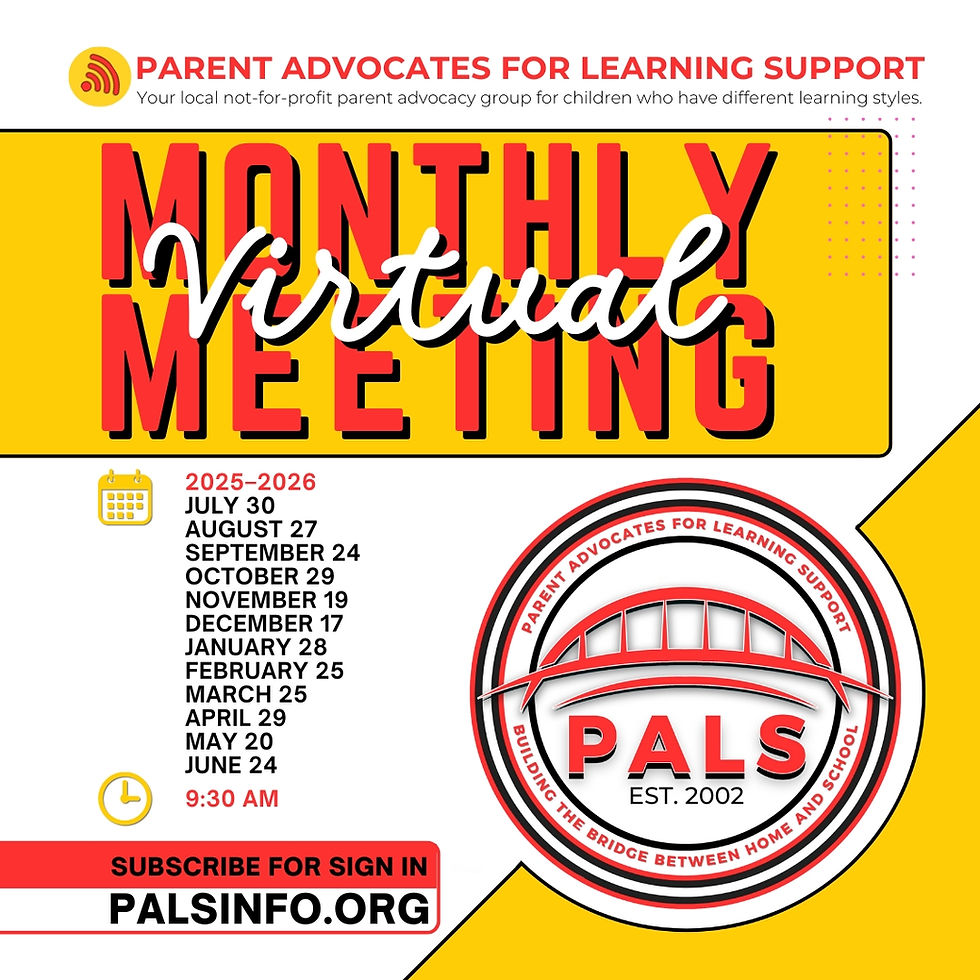
Next Meeting: October 29, 2025 9:30 a.m. Virtual Meeting using Zoom.
Log in for all meetings included in every newsletters. Become a subscriber in the footer.


Comments